Many decades ago Frank Knight stated the point of this Substack as he sketched out the knowledge problem.
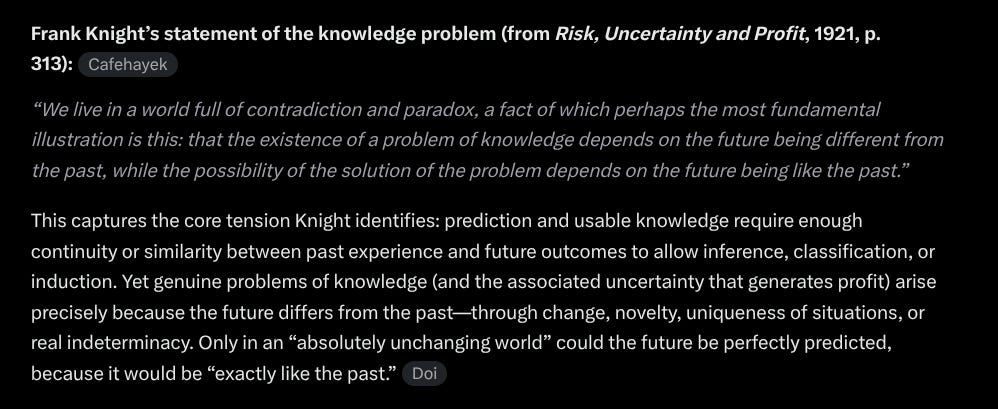
My Claim: Economics and economists will always face the joy and the challenge of the knowledge problem while Math scholars work in a stationary setting. The set of possible ideas already exists. The needles are already in the haystack; but the nerds haven’t found them yet. AI has accelerated the Math directed search towards the truth (i.e math proofs).
Terrance Tao has argued that there will be a serious cost. As AI shines, young math scholars will grow discouraged and reduce their effort and the aggregate human capital stock will decline. Old math guy effort will decline as they will play more golf and tweet more about their latent luddite feelings.
Why Will Economists Avoid this Fate?
While we have our basic ideas of the gains to trade, supply and demand, investment under uncertainty, asset pricing and basic game theory; the setting we study is always changing and this makes the permutations almost infinite. Trump, COVID, WFH, War, China Shocks, potential hyperinflation, trade shocks; keep hitting the system and the market evolves. The Hayek knowledge problem guarantees that Economics and AI are complements.
If the AI can’t handle the Lucas Critique in the presence of Heckman heterogeneity. Each of us has our private type and we choose to be this type through the choices we make. We optimize given our goals and what we know about ourselves and our future. The price system imposes the aggregate budget constraint. This yields interesting time series paths of our choices over how we allocate our time and what we buy over time. The empiricist can study the micro and macro data patterns but the time series properties of these processes offers some “causal effect” estimates but these can’t take the heat of the Lucas Critique.
Given that there are no stationary time invariant parameters of firms and consumers; the AI can never do to economics what it has done to math.
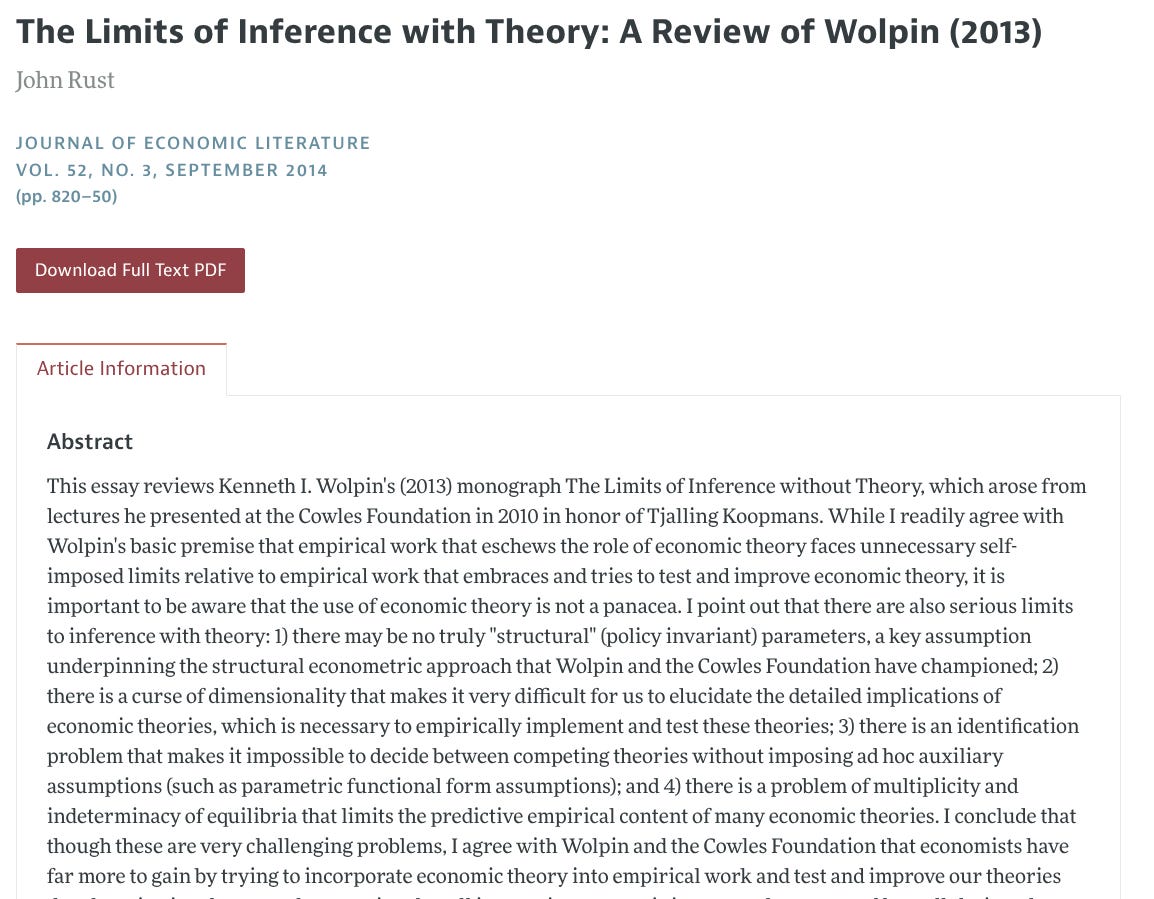
Here is an under-rated JEL paper by John Rust. This paper was written before the AI revolution but it anticipates the challenge that structural economists face. They demand that researchers use structural models to explain data patterns but Rust wonders if there are any time invariant deep parameters. Math has those, we don’t. The Knight Knowledge Problem persists!
In the 1950s, Hayek and Lange had their debates about market systems versus central planning. In 2026, how does the Chinese CCP use AI to improve its 5 year plan? Is there evidence that this technology is leading to “better plans”?
I claim that in a stationary setting such as solving an Operations research problem with a known technology and known input prices that the AI can instantly solve this. Any inefficiency here regarding the cost of the old solution will vanish. If cost minimizing entity knows that it doesn’t know how uncertainty will play out; it may want to play a cautious”wait and see” strategy with many real options baked in. Could an AI really solve for all of these paths when we can’t even delineate all of these states of the world?
So, if Ken Arrow wrote a paper in 20226; can we delineate all of the states of the world and possible contingencies? If we can’t then we live in Knight’s world.